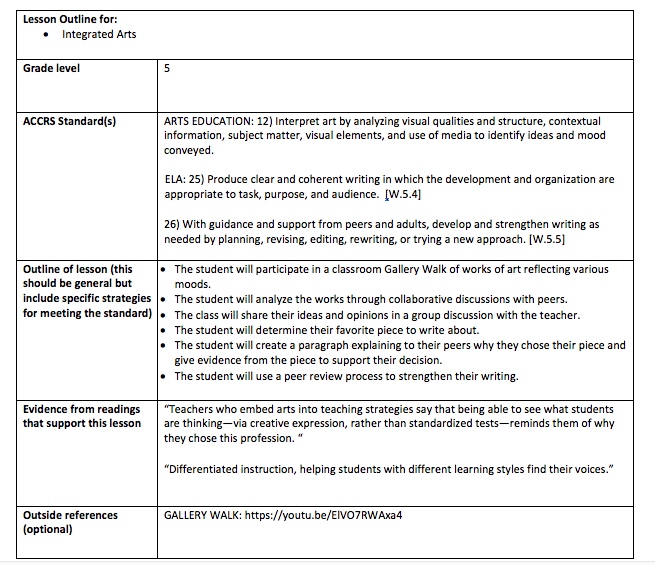
Integrated Arts
The article Arts Integration Improves School Culture and Student Success by Cheri Sterman (2018) offers a look into the positive impact that arts education has on school and student success. According to L. Earl Franks, arts education is “an essential part of well-rounded education.” There are many benefits to integrating arts education in the curriculum. Integrating the arts results in higher student engagement, a collaborative learning environment, attracting and keeping teachers in schools, and allowing teachers to use culturally responsive pedagogy. It also provides a way to easily differentiate instruction and encourage creative problem-solving that leads to career readiness. Arts integration has proven results of enhancing overall student achievement, as well.
Having studied art education in my undergraduate degree, I was most intrigued by the statistics that prove the increased success in student test results and increased math and reading proficiencies. Art educators are often forced to validate their work that is not quantifiable. However, through integrating the arts into the daily classroom, we can see clear quantitative results. Also, I had not considered the impact that arts education can have on ELLs. We must consider the use of universal languages like the arts to help ELLs find success in the learning environment.
References
Sterman, C. (2018, January/February). Arts integration improves school culture and student success. Retrieved from https://www.naesp.org/principal-januaryfebruary-2018-comprehensive-learning/arts-integration-improves-school-culture-and-s
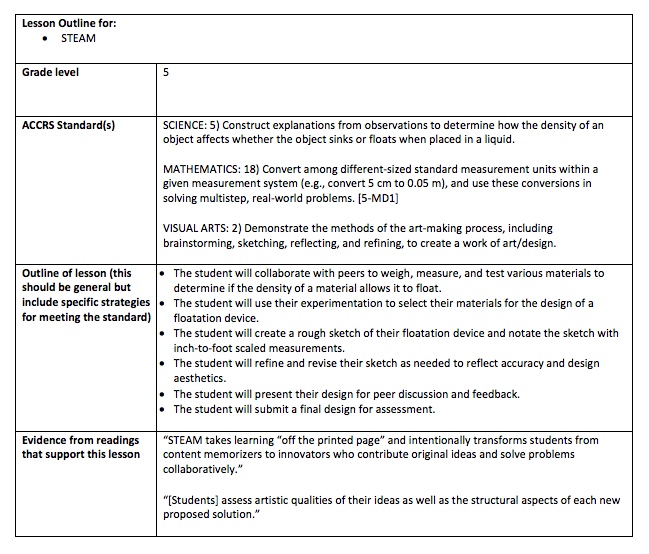
STEAM
In the article STEAM Ignites Learners’ Energy, Cheri Sterman (2017) relates the ideas of using STEAM and student-centered learning to create leaders out of learners. By adjusting the learning environment to focus on students’ creative success and execution of projects, students become more engaged and able to work within real-world standards. STEAM encourages students to be intuitive investigators who are able to analyze problems on a higher thinking level. Beyond this, STEAM also sparks innovation and invention in students, requiring the engineering and design of new projects. Schools that utilize the STEAM pedagogy to engage students also see higher test scores and lower discipline referrals.
STEAM is a very important concept in my teaching career. I plan to focus my teaching in math and sciences with the integration of the creative thinking of the arts. It is very important that we prepare our students as best we can for their future in the real world. STEAM is an overdue bridge for the disconnect between education and the real world. It is also important that we develop leadership qualities in our students as our world is in dire need of thoughtful, well-rounded, educated leaders.
References
Sterman, C. (2017, September/October). STEAM ignites learners’ energy. Retrieved from https://www.naesp.org/principal-supplement-septemberoctober-2017-champion-creatively-alive-children/steam-ignites-learners
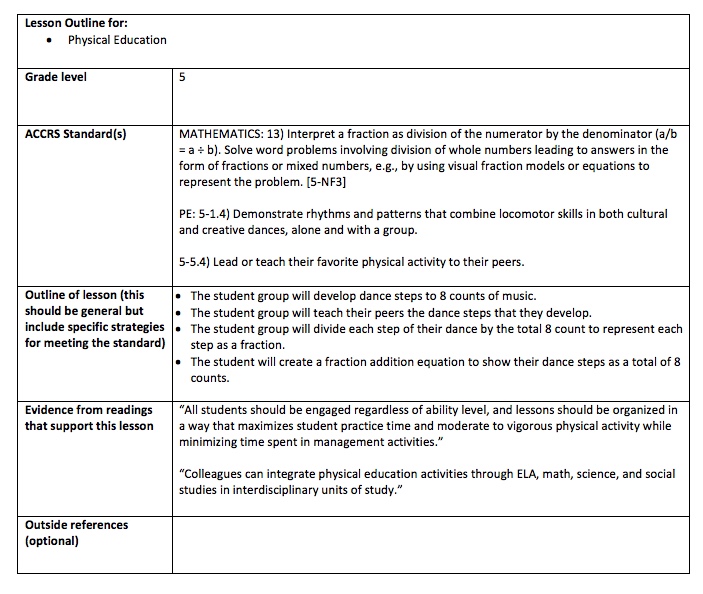
Physical Education
The article Shake Up PE’s Status Quo by John T. Foley, Lynn C. MacDonald, and Daniel J. Breiman (2018) discusses how physical education benefits students’ immediate and long-term physical and mental health. Physical education is often underappreciated because its true purpose and impact is misunderstood. In order to make it better appreciated by everyone involved, administrators should take time to properly evaluate how standards are being met and what needs the physical education teacher expresses. If properly executed, a successful physical education program can lead to cross-curricular lessons and knowledge of physical health for a lifetime.
I believe physical education is imperative to a well-rounded education. I also see it as an opportunity to incorporate multiple critical processes necessary for full development and learning. Physical education is an essential component to the mental and physical health of our students. Every test preparation program I have participated in describes a physical component as a mandatory aspect to success. This is because physical activity and awareness lead to the betterment of thinking.
References
Breiman, D., Foley, J., & MacDonald, L., (2018, November/December). Shake up pe’s status quo. Retrieved from https://www.naesp.org/principal-novemberdecember-2018-safe-healthy-schools/principal-novemberdecember-2018-safe-healthy-sc
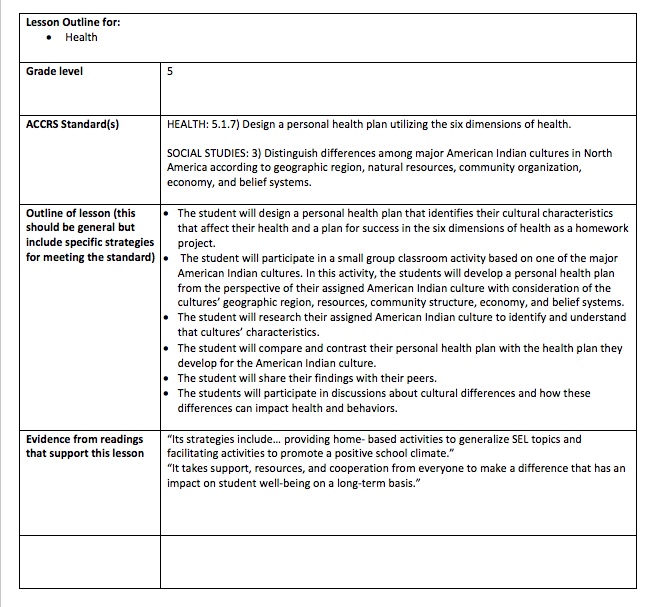
Health
In the article A Culture of Caring, Jennifer Lenz, Lisa Micou, Connie Honsinger, and Rachel Bulifant (2018) explain the importance of social-emotional learning (SEL) in the classroom. SEL is a necessary component for a safe and healthy school environment for everyone involved. One of the SEL curriculums that has proven itself as effective is Caring School Community. The program employs various SEL activities in the classroom, school, and at home. As with any instructional curriculum, there must be a form of assessment of the students’ learning. Some schools implement the Devereux Student Strengths Assessment. This assesses students’ needs as well as their strengths and weaknesses related to SEL. It is also important to involve teachers in reflecting on the curriculum and maintaining personal physical wellness. Through these curriculum programs, parents become more involved and students become more aware of their regulatory zones (angry vs. ready-to-learn).
As a teacher candidate, this article is very interesting to me as student engagement is the center of the learning process. Student engagement requires social-emotional learning that may not come naturally to students. However, one can create habits with repetition and deep understanding. Regulating one’s emotional state can be a learned practice if we incorporate SEL in the classroom and at home. Mental health is essential to learning, and SEL presents a proven path to enhancing mental health.
References
Bulifant, R. Honsinger, C., Lenz, J., & Micou, L., (2018, November/December). A culture of caring. Retrieved from https://www.naesp.org/principal-novemberdecember-2018-safe-healthy-schools/culture-caring
 Beth Rush Teaches