Part 1: Quality Questioning Responses
As a lifelong learner and teacher, I am committed to generating and exercising new critical processes in my students’ thinking. Quality questioning is a great tool for effectively producing new thought processes and critical thinking. This works hand-in-hand with my personal educational philosophy. I will commit to using quality questioning in my classroom by utilizing the 6Ps suggested in the book Quality Questioning. First, I will take the time and effort to strategically plan quality questions and possible scaffolding responses for each question based on the student group I am working with. One of the key features of quality questioning is the inclusion of all students as participants in the response process. This requires a relationship with each student individually as well as a collective classroom culture geared towards finding value in learning and excitement in new discoveries. When presenting the question to the class, I will employ the 4 discrete practices including an expected response structure that enables all students to think further, engaging students in responding, allowing thinking time between questions and responses, and eliciting student responses, especially from non-responders. I will prompt student thinking after allowing thinking time as well as develop follow-up questions to scaffold student understanding for students who may need more guidance in their thought processes. I will then process student responses and facilitate discussions, hoping to lead the students to higher-level thinking. When all is said and done, I will reflect on my questioning practices and set targets for improvement.
The rubric provided in chapter 2 can be used as a tool for modifying and creating effective lessons and quality questions. One of the most important aspects of teaching is reflecting on the effectiveness of your practice. By reviewing the rubric, teachers can better understand where their lessons and quality questions might fall short. It can also help in identifying successes which can be mimicked in other lessons and questions. By aligning the content focus with the instructional purpose and levels of cognitive processing desired teachers can better stimulate and focus their students’ thinking. By analyzing the wording and syntax of lessons and quality questions, teachers can assure the best communication that leads to student comprehension.
The response structures that most resonate with my teaching style are mostly the structures for deep thinking. Developing critical processes in my students’ thinking is a high priority for me as a teacher. I truly believe that every concept presents an opportunity to critically think. I really appreciated a few of the structures, as they were unfamiliar to me before reading this chapter. In line with my love of mathematics and statistics, I will use the Peoplegraphs and Data on Display structures in my classroom. Often mathematics can seem detached from other subjects as well as from students’ real lives. These structures provide a great way to integrate mathematics into other subject areas as well as creating an understand of how math is applied in everyday life. These methods also present an opportunity for students to better their understanding or structure, organization, prioritization, and trends. I appreciate that they also involve physical activity which can accommodate learning styles and disabilities that are more difficult to differentiate. I will also utilize the InkThink structure in my classroom. Students need to actively participate in the building of concepts and scaffolding of ideas. This method is a great way to get students thinking critically about how far an idea can advance and how collaboration can open new doors in thinking. I also like that this activity minimized the need for verbal communication. This will help with students whose strengths lie outside the verbal spectrum. I will likely utilize all of the structures presented in this chapter in the classroom and home in on the structures that work best with each class. In the ever-evolving classroom, it is an advantage to have a wide range of tools to utilize based on the needs of the students.
Thinking back on the lessons that I’ve taught and seen taught, two major benefits of providing Think Times as explained in chapter 4 become apparent. First is the benefit of full class participation. It is easy to fall into the cycle of focusing on students who seem interested and engaged. However, this is selectively educating students and allowing others to fall to the side. The goal should instead be to figure out how to engage all students. By providing Think Time for all students to think in a risk-free environment, all students are inherently engaged. The second benefit I note is forming a habit out of higher-level thinking. The more the students interact on a critical thinking level, the more adept they become at reaching that potential with all questions. I would love nothing more than to have a classroom full of engaged critical thinkers. Through conditioning myself and the students to respect and utilize Think Times and rules for discourse, I will be able to better optimize the learning process and my students’ development.
Chapter 5 emphasizes converting a student response into tangible feedback for both the student and the teacher. This requires multitasking on the teacher’s part. The teacher must maintain focus on the learning goals and the desired cognitive levels of the discussion while constantly analyzing the responses from the students to determine the level of comprehension in the students’ thinking as well as the cognitive level of the students’ thinking. Then the teacher must respond to the possible gaps between these levels and goals and address them before moving the discussion forward as to not abandon any of the students and maximize participation. Personally, I think the most difficult part of this process will be creating scaffolding quickly enough to close the gaps in student knowledge. This will require lots of thinking-on-my-toes which can sometimes be difficult for me as I get into progressing the discussion. However, this process must be implemented to optimize learning and maintain student engagement. To implement this challenging approach in the classroom, I will constantly evaluate student responses and modify my practices to achieve higher quality responses. I will also actively listen and teach my students how to actively listen to their peers and me. Listening is an essential component of evaluation. I will also aim to distribute feedback to my students fairly and consistently. It is important to balance feedback to the students as to not halt the discussion or discourage responsiveness. Scaffolding learning during the response process is also a critical component in progressing the discussion towards the learning goals. Scaffolding fills in the gaps that some students display in understanding. By leveling the playing field, teachers can elevate the discussion to higher level thinking.
Part 2: Quality Questioning Miro Board
Click here to view my Quality Questioning Miro Board
Miro Board offers a relatively user-friendly interface for collaboration and creating visual idea boards. I found that many of the functions within Miro Board mimic Adobe Creative Suite functionality. This is very useful if you are familiar with Adobe. Overall, I found success using Miro Board to scaffold my learning through the book Quality Questioning. It took a few tries to figure out which template to utilize to match my note-taking method. I finally landed on modifying the Business Model Canvas. I wish that it was easier to combine multiple template types together as I could have utilized some webbing within certain notes. However, it did not hinder the effectiveness of the tool.
Part 3: Quality Questioning and Teaching Math Using Number Talks
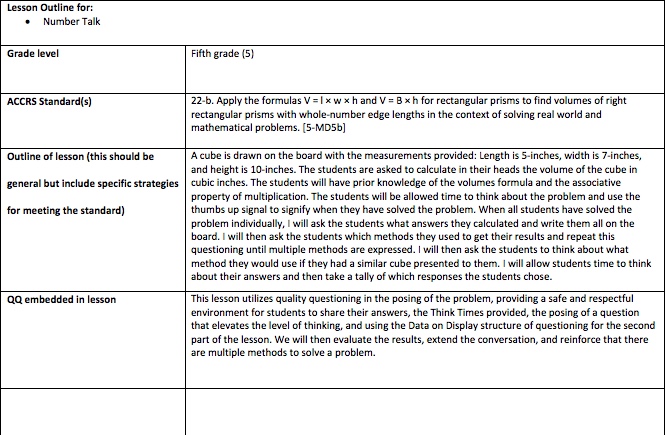
Number talks are a great strategy for developing computational fluency. It provides an opportunity to practice math concepts outside of the context of math instruction. It also allows students to take ownership of their concepts. This is important in not just the development of computational fluency, but also in the assessment of math comprehension. As I tell my nephews, the only way to be good at something is to practice. This is great practice for a lifetime of mathematical understanding.
Part 4: 21st Century Tool Review
socrative.com
The first 21st Century tool I found was Socrative. I saw the tool on the list of response structures in Chapter 3 of Quality Questioning, and then I came across the tool again on Twitter. This meant I had to check it out. I definitely think it’s worth the time to learn about it. Socrative is an assessment app that is very user friendly for both the teacher and the students. It is free for students and has a limited free version for teachers. The Pro version costs $60/year. It requires that students be familiar with their device and general app navigation skills such as clicking and typing. The app allows for quizzes, quick questions, and taking class counts. It also offers the options of presenting the questions as quizzes, races, or class exit tickets. Socrative allows for multiple question types such as multiple choice, true or false, and short answer. This app lends itself to the quality questioning methodology. Creating follow-up questions on-the-fly and monitoring student feedback in real-time are just a couple of the benefits that align with quality questioning. Socrative is sure to engage all of the students in a class in actively assessing and scaffolding their learning. It also encourages students’ self-assessment, which is an essential benefit of quality questioning.
www.polleverywhere.com
The next tool I found is PollEverywhere. I found this app while searching Twitter, as well. It seems like a great way to integrate questions and polling into a presentation or class instruction. It allows for integration into Powerpoint Presentations, which is very useful. It is free for the students to respond either via text message or through a web browser. This means that the students must be familiar with either SMS technology or web browsing, depending on the device they use. PollEverywhere offers a lot of flexibility in design and formatting of questions. However, it is less kid friendly than Socrative seems. Combined with the required knowledge of web browsing, I would only venture to use this platform with students in the upper-elementary levels. It is still a great tool. For teachers to have abundant access to reporting and moderating, the cost is $50/year. Similar in connections with Socrative, PollEverywhere is a great tool for quality questioning. It provides a way for every student to actively engage in the assessment process. Through its integration with Powerpoint, it can be used to continuously assess feedback from students to gauge where they are in reaching the learning goals. This gives the teacher the ability to recognize and close learning gaps as needed. It is also useful to have many question structures available as content is not one size fits all.
 Beth Rush Teaches